Sunday, October 25, 2015

Two Horses Killed - Slippery Streets in the Age of the Steamer - 1914

Hills & Winding Roads Prove Deadly in Steamer Accident
15 April 1914


Newspaper Headline 16 April 1914
Cincinnati Enquirer


     Two boys were out causing trouble on the campus of Xavier College on Thursday April 15, 1914.  They lit a fire, intentionally or accidentally it is not known, then took off.  Firemen at Engine Company 39 were looking forward to lunch.  The bells rang above the joker stand as an alarm of fire was taken.  The horses, Bull and Roxie, rushed forward to their harnesses and the doors of he house flung open.  Snaps were fastened and the men jumped aboard.  In seconds the engine was off, tearing across Montgomery Road and down Clarion Avenue.  Rain had been falling steadily making the roads treacherous.  Once at the bottom of Clarion the engine made a left turn onto Dana.  The driver, Frank Voellmecke, noted the roads to be very slippery as he passed through the intersection with Woodburn.  With no details about the fire speed remained a priority but care had to be taken.  Hills and bends were a serious threat even in the best conditions.  Horses were driven to pull the heavy engine but once it got moving it could be difficult to stop.  The horses could be unpredictable, despite their training. 


Engine Co.39 as it appeared around the time of the accident.
E39 & Hose Wagon 39 pictured
Courtesy Cincinnati Fire Museum


      The engine continued on and started into the intersection with Winding Way.  Xavier College was to the right and the company was nearing the fire.  Suddenly, as the engine swerved to the right turning onto Winding Way, Bull slipped and fell causing Roxie to be tossed to the ground as well.  The animals let out a terrible cry.  The weight of the engine tossed the horses into the curb with the engine coming to rest on Bull whose neck was broken.  He was killed instantly.  As the engine was thrown to the side of the road it struck a telegraph pole.  Voellmecke was spit from his seat breaking his shoulder as he landed nearby.  Roxie was writhing in agony having sustained a broken leg.  The engine itself was damaged and would require service before it could be placed back in service.


Frank J. Voellmecke
Courtesy Voellmecke Family Collection


     Chief Bunker learned of the accident as he neared the fire and rushed to the scene in his automobile.  The department had only recently started switching from horse pulled steamers to new mechanized auto pumpers and Engine 39 had not yet been changed.  Accidents such as these were one of a number of reasons why it was argued that the change to auto pumpers was a necessary one.  The chief helped to package Voellmecke up and drove him home.  A mounted police officer arrived and euthanized Roxie with his pistol.  Chief Bunker notified a police detective that two boys had been witnessed running from the college just as smoke was seen.  


Engine 39 Joker Stand
Courtesy Cincinnati Fire Museum


     Soon horse pulled steamers would be a thing of the past.  The Cincinnati Fire Department had set the standard model by which all other fire departments followed for 60 years.  Horse drawn steamers operated by paid professional firefighters was a system that worked.  As technology made jumps the world was pulled into the future.  Automobiles were running along the same streets as horse pulled vehicles.  Horses were easily startled by these heavy machines.  It was clear that they would not both occupy the streets together for long.  The fire department had been luck on this day.  Voellmecke was injured and two horses were killed in the wreck but the results could easily have been worse.  The fire department had already witnessed a number of members killed in traffic accidents during responses.  Indeed the response itself was often more dangerous than the emergency the men were confronted with.  


Chiefs Report regarding the accident at Dana and Winding Way
Courtesy B.Houston Collection


Montgomery and Clarion as they appear today - Engine 39s former quarters at the intersection 
E39 crossed Montgomery and started down Clarion prior to the wreck
Google Street View


Report of the City Veterinarian regarding the wreck and the death of two department horses
Courtesy: B.Houston Collection


The intersection of Dana and Winding Way as it appears today. To the right a parking area for Xavier University can be seen
Google Street View


Thursday, October 15, 2015

Collapse of the Dater House

Collapse of the Dater House - 03 September 1877

     A terrible construction accident brought members of the fire department together in a search for survivors on Monday September 3, 1877.


Cincinnati Enquirer 04 September 1877
Headline of the story that appeared in the Enquirer following the collapse


     For a couple of weeks work had been progressing on the demolition of No.76 Longworth Street.  That building was owned by the Weighell Brothers, tobacconists.  Finally the structure was cleared from the site and the work of preparing a cellar for the new factory was started.

     No.74 was a 3 story brick tenement immediately next door.  The building was constructed around 1847 and was said to have been poorly built.  In order to deepen the cellar of No.76 the contractors dug below the level of the foundation of No.74.  They used a bank of earth and gravel to help stabilize the wall of No.74.  It became clear that No.74 would need to be shored up in order for the project at No.76 to continue.  Gilbert Dater, the owner of the tenement, hired a company to accomplish the shoring work.  Work to stabilize the structure started on Monday September 3rd in the morning.  The plan was to drill several holes in the walls so as to use wooden planks and jacks to support the wall along with bracing.  Conflicting reports are offered regarding notification residents received from the property owner.  Ultimately the only person that seems to have moved to safety was the occupant of the basement and that was largely because the work was taking place in that space.

     The Dater House was occupied by Susie Keam the keeper of the house and her husband, Ada Price, Mrs. Louie Dowling, Kittie Grant and John Disten, Laura Miller, Mertie Gray and her friend Henry Johnson, Laura Miller, Lottie Williams, and a servant girl named Mary - The construction men in the basement were working under foreman John Finnegan and included Hugh Quigley, Patrick Boyle, Pat Flaherty, and Conrad Leyden.

     The construction crew worked through the day cutting holes into the wall and digging corresponding holes in the basement floor so as to set jack screws to support the wall.  All of the cutting and digging coupled with the already weak nature of the wall and the earth that had been removed while digging out the cellar in the neighboring building was too much.  At around 3:40 in the afternoon there was a thunderous crash as the building collapsed.

     The work of digging a cellar next door at No.76 had also been ongoing.  John Mehen, Jerry Colter, Tim Maher, and John Quinn were loading soil into a cart driven by John Reilly.  The men were warned of the impending collapse by a fellow workman standing in the street.  The men immediately jumped into a preexisting coal cellar that was in front of them.  The cellar was sheltered under some pavement.  This jump saved the men's lives.  The mule and cart they had been filling was buried to the reins with brick and debris.  The noise had been great enough that it was heard a couple of blocks away at the Gifts Engine House.  In minutes there were people running up to the house calling for help.


Cincinnati Enquirer 04 Sept 1877
Illustration of the scene as it appeared in the Enquirer


     Firemen responded with the Phoenix Hook and Ladder Co.1 along with Assistant Engineer Joe Bunker and Jakey Hughes.  Scores of volunteers assisted the firemen and police in digging through the rubble in the search for survivors.  Mertie Gray and her friend Henry Johnson were the first to be rescued.  Kittie Grant was next to be saved.  She had also had luck enough to survive the Robinson's Opera House disaster in February 1876 when a false call of fire in an overcrowded venue resulted in a rush of people to the exits.  Nine women and children were trampled to death in that incident.  Near her was John Disten.  One of Finnegan's workmen, Conrad Leyden, was found on the steps of the buildings Longworth Street entrance.  In the rear of the structure firemen were searching an area from which could be heard a woman's voice calling for help.  Here Susan Keam was found crushed to death near Lottie Williams who had been calling for help.  More calls for help were heard from around the entrance and workers rescued Pat Flaherty from this location.  He was shaken and had some minor injuries but after being looked over by a doctor he immediately returned to the scene to help search for his missing coworkers.  Flaherty had been working near Hugh Quigley and knew he would be close.  Hugh was found dead in the rubble soon after.  Louise Dowling and Laura Williams were soon rescued as well.  Next were found Ada Price and Myrtle Gray who both survived the ordeal.  By 5:00 all but one had been recovered from the building.  Foreman John Finnegan was still missing.  Fire Company No.12's diary is the only known company diary to survive from 1877.  It records the event and notes that a couple of men were sent to the scene from each company to aid in searching for survivors and digging through the rubble.  By 7:00p Finnegan had still not been found and a fire was built atop the debris to light the scene.  When the fire failed to provide enough light a calcium light was placed on the roof of a neighboring store and a tree chopped away to provide more light.  Finally around 9:45p Finnegan's body was discovered crushed under the rubble.  The mule and other heavy debris was removed with the use of a hoisting rope.


Mohawk Fire Co.12 Diary c.1877 (BHouston Collection)
Entry for 03 September notes the collapse of the house on Longworth near Elm and indicates 2 men from each
company detailed to the scene.  At the time E12 was still located in the Mohawk Neighborhood (This would change later in the year).
The diary also notes a large loss of life at a fire in New York.  This is a reference to the Hale & Co Piano Factory Fire that took place on the same
date.  The initial estimate of loss was very high but ended up being much lower.  As many as 80 buildings were lost or damaged.

Cover of Mohawk Fire Co.12 Diary for the year 1877
(BHouston Collection)


     Over a hundred firemen, policemen, and volunteers helped dig through the rubble.  Ultimately three of the people inside the Dater House were killed.  The event highlights the dangers associated with the building trades as well as the absence of laws and regulations to govern construction and building safety at the time.

The Persons Lost in the Collapse:
Susan Keam
Hugh Quigley
John Finnigan


A Calcium Light (Limelight) - This was a 19th Century form
of theatrical stage lighting.  A piece of lime would be burned by an oxyhydrogen flame
creating an intense light.


Thursday, October 1, 2015

J. Rush Thomas - Newly Uncovered LODD - 1873

John Rush Thomas - Tossed From His Horse & Killed 
03 April 1873

     Though not completely forgotten, the death of Rush Thomas has for decades been unacknowledged.  His story was lost save for an article published in the Cincinnati Volksfreund in 1874.  The article recalled a short history of the fire department and concluded with a list of members who died in service to the department.  This appears to be the earliest such list.  Deaths of members were recorded in each annual report if they met the given criteria of the age but there was no running list maintained or at least no running list that survived.  Unfortunately many of the annual reports are lost and as such a great deal of research has been necessary to compile a list of members that died while in service to the citizens of Cincinnati.


Cincinnati Enquirer - 04 April 1873


     Rush Thomas was out with the horses for their afternoon exercise.  On his way back to the quarters of Engine 13 he heard the bells calling the men out to a fire.  Bringing the horses to a gallop he made a dash back to the house.  He arrived and tried to dismount as fast as he could.  It is not known if the horse reared up or if he simply slipped but he fell to the ground striking his head.  He died that same day.  The engine had been dispatched for a fire at the corner of Central and Poplar.


UC Death Index Card - John Rush Thomas


     Thomas left behind a wife and three children.  He was almost 41 years old and had a long record of service with the department.  He was previously a member of Engine 05, The Jefferson Engine Company.  The funeral services took place at his residence, 27 Bank Street and he was laid to rest at the Wesleyan Cemetery

1872 Fire Department Annual Report shows J.R.Thomas as a member
of The Jefferson Steam Engine Co.5

     The early list of members killed in the line of duty was printed in the Cincinnati Volksfreund in 1874 and reprinted in December 1999 in the quarterly publication of "Tracer" produced by the Hamilton County Chapter of the Ohio Genealogical Society.  A link to the article can be found here:

The following information will be added to the Roll of Honor of the Cincinnati Fire Department:

John Rush Thomas
Driver - Brighton Fire Co.13
Died 03 April 1873
Fell From Horse - Head Injury


Thursday, September 17, 2015

LODD Update - Harry Benninger

LODD Memorial List Update - Harry Benninger


Newly Uncovered Line of Duty Death


     Members of Hook and Ladder Co.1 experienced a horrible accident on December 17th 1914.  Harry Benninger, a member of Engine 34 who had been detailed to the ladder company for the day, was returning from lunch.  As he walked down 6th Street toward the Gift's Firehouse an alarm of fire sounded.  He rushed toward quarters arriving as the ladder was pulling out.  As the truck turned west on 6th Street Benninger jumped for the running board.  In his rush to join the company he slipped.  Before anyone could react the apparatus had rolled over him.  A wheel passed over his head and chest crushing him.  The sidewalks were busy with pedestrians who were sickened to witness the accident.  Patrons of the Palace Hotel restaurant were also able to see the scene from their seats.  Harry was immediately carried to the City Hospital but doctors were not able to save him.  He was pronounced deceased on arrival.


Cincinnati Enquirer - 18 December 1914


     The alarm of fire the companies were responding to originated at the May, Stern & Company store.  It proved to be a false alarm triggered by an overheated system.  Benninger lived at the Delmar Flats on Telford Street in Clifton with his elderly mother.  Chief Bunker personally made the trip to her apartment to pass along the news of her sons death.


Courtesy Cincinnati Fire Museum
Hook & Ladder Co.1 pictured here in 1900.  The scene of the accident would have looked very similar to this.
Ladder 01 was not mechanized until 1917.


     Two days later the funeral procession passed Engine 34s quarters as it made the trip to Spring Grove Cemetery.  Harry's four brothers attended the service along with their elderly mother.  Members of E34 along with Chief Bunker and several assistant marshals stood at attention outside quarters as the group passed.


Find a Grave Index
Harry Benninger - Spring Grove Cemetery section:  LN-31-2-15


Spring Grove Cemetery - Burial Record


     The following information has been added to the Cincinnati Fire Department Roll of Honor:

Harry Benninger
Firefighter - Engine Co.34 (Detailed to Hook & Ladder 1)
Died 17 December 1914
Accidentally crushed under apparatus while jumping on board


     Training note for active firefighters >>> Vincent Dunn's book Safety and Survival on the Fire Ground identifies attempting to jump on or off a moving apparatus as a highly dangerous practice.  Firefighters are reminded to always be aware of their surroundings, things they may trip over, and the location of the apparatus while on the fire ground...particularly when the apparatus is moving.  The most dangerous position for a firefighter is to be inside the turn of an apparatus.  In this position the firefighter that is too close to the apparatus has a high likelihood of being run over by the rear wheels in the event that he should fall.  Dunn notes, "firefighters have been crushed to death beneath the wheels of moving fire apparatus after failing in their attempts to jump aboard."  We owe it to those that came before us and lost their lives to learn from their experiences so that we might not repeat the same tragic mistakes.


Monday, September 14, 2015

1938 Parade and Demonstration

Cincinnati Celebrates 150 Years - The Sesquicentennial Parade 

     The City of Cincinnati celebrated its 150th birthday on Tuesday October 11th, 1938.  The centerpiece of festivities was a great parade with floats designed to capture the history of the city.  Leading the parade was a prominent Cincinnati businessman dressed as Cincinnatus and riding in a Roman chariot.  Among the most interesting parade entries was an original Wells Fargo stagecoach on which can be seen scars from bullets and arrows earned in its earlier working life on the frontier.

Original Wells Fargo stagecoach


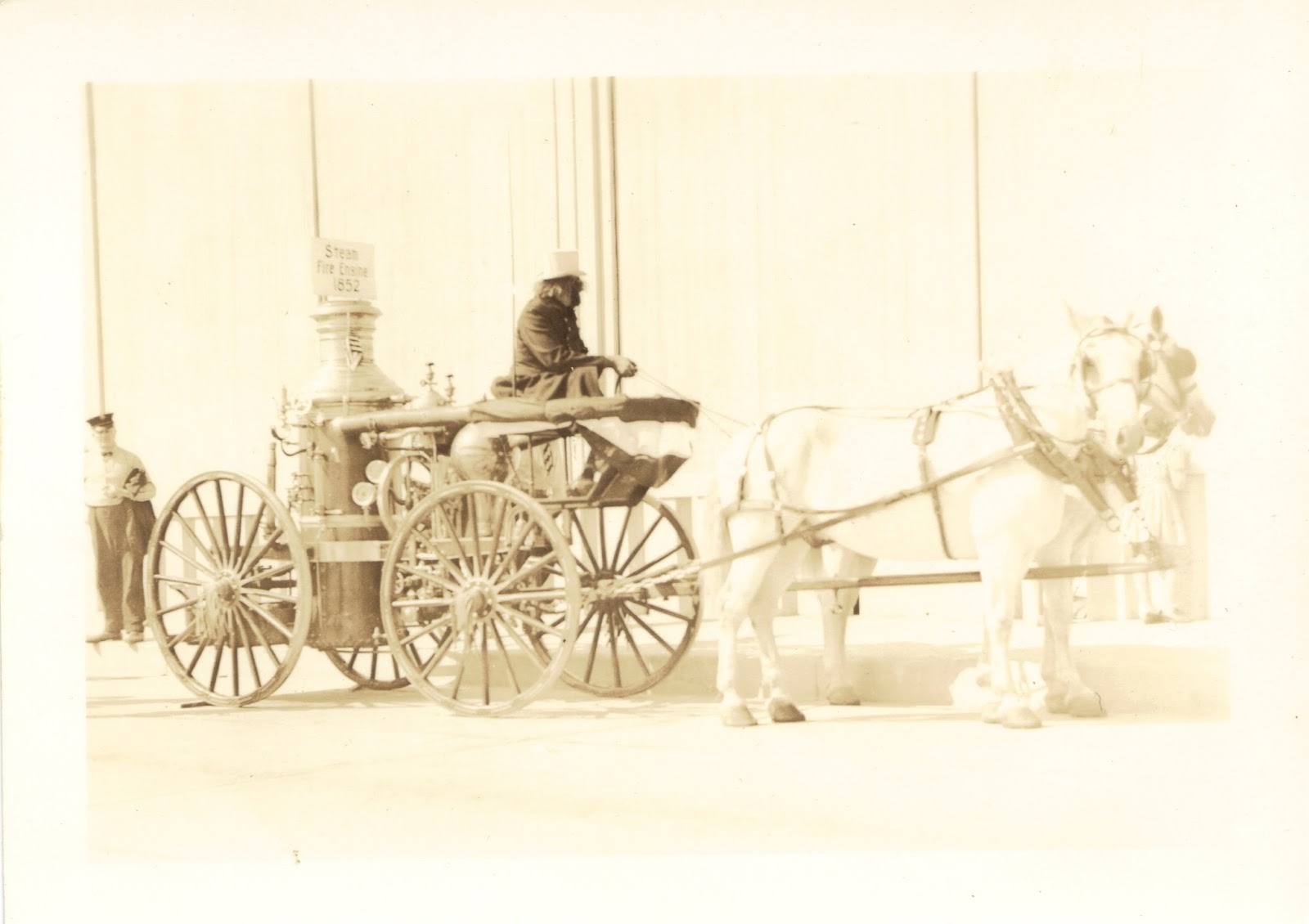
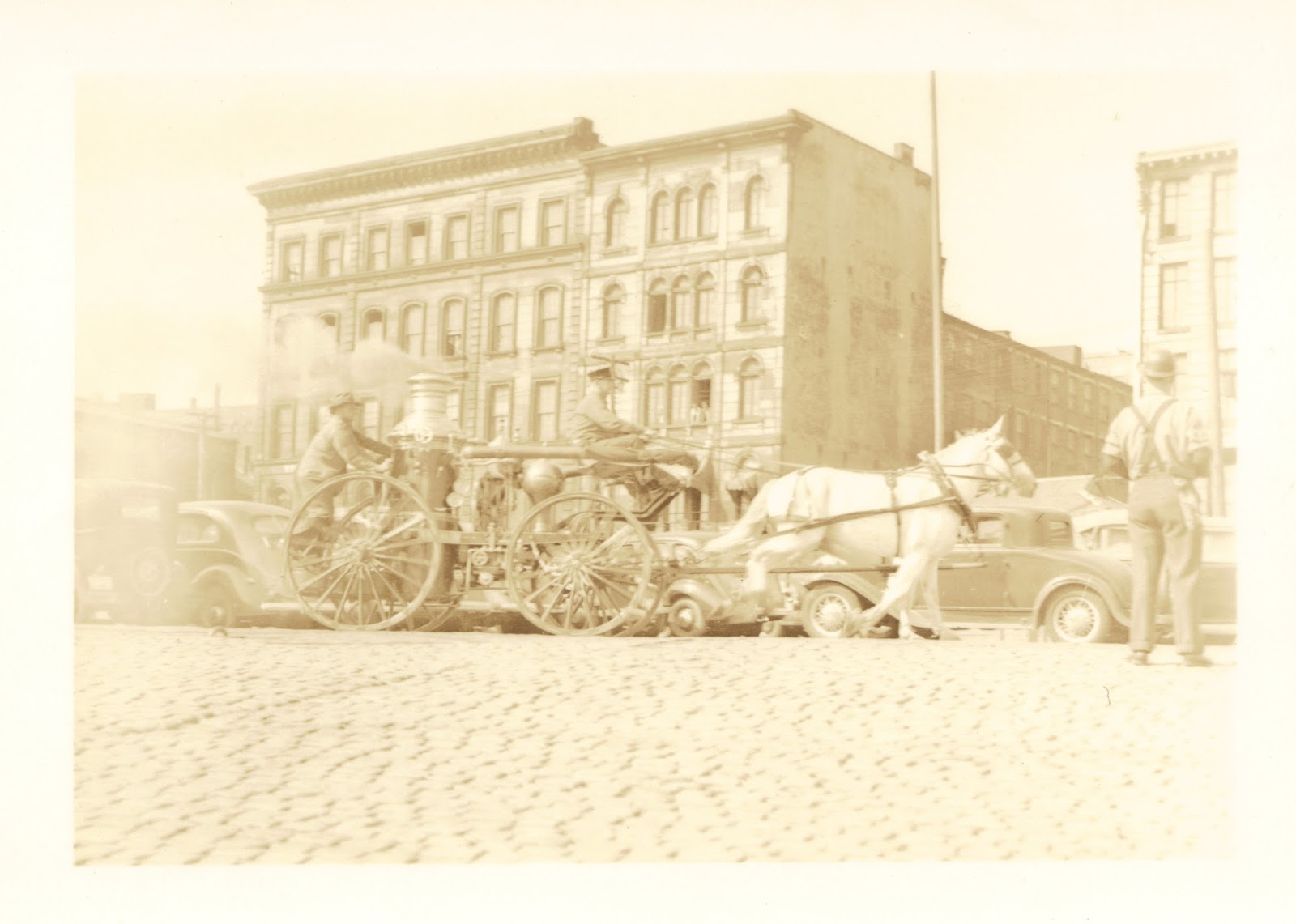
     The fire department marked the occasion with old fire apparatus.  Members dressed as old time volunteers.  The fire department band lead the group followed by a flat bed with the original fire drum which served as the first city fire alarm.  Hand pulled pumpers and horse drawn steamers joined modern apparatus in the parade.  After the  parade the fire department put on a display at the public landing.  A hand pulled pumper was rushed to the water followed by a horse pulled steamer and both were put in operation recalling the great battle that took place on New Years Day 1853 between Union Fire Co.9's powerful hand pumped apparatus "Ocean" and Shawk and Latta's new horse pulled steam apparatus the "Uncle Joe Ross."


     The events were well documented and we are left with some fantastic pictures from the event.  Better still is the surviving video which captures the demonstration of fire apparatus at the public landing.  Check out the link to the video at the bottom of the post!!!

The original fire alarm - The fire drum


Chief Barney Houston pictured on right


Horse pulled steamer rushes to the water at the public landing


Hand pumper pulled to the waterfront with runners


CHECK OUT THE VIDEO HERE...1938 Steamer Demonstration Video


Thursday, September 10, 2015

Cincinnati's September 11th Tragedy

Cincinnati's September 11th Tragedy


     Long before Americans witnessed the terrible losses of 9/11/2001, the Cincinnati Fire Department experienced a tragedy of its own on September 11th.  The year was 1899.  Fuel Wagon Driver Thomas Bland was going about his business at Engine 08's quarters when Officer Lowenstein came running down the street calling for help.  The officer had heard screams just around the corner from the firehouse and he rushed to there to alert the firemen.  Bland heard the plea and raced to the scene by himself.

     Carl Dent was likely clinging to his mother's side.  She was beside herself with fear for her other son Monroe. Carl the oldest at five years of age was playing with four year old Monroe in the back of the family home, a two story brick tenement at 727 Clinton Street.  Behind the building was the privy house.  Carl and Monroe were hanging on the swinging door of the outhouse.  His arms draped over the door, Monroe got tired and tried to lower himself to the ground without falling.  He lost his balance and fell into the privy vault some 30 feet below.  Carl rushed to his mother's side and it was her call for help that alerted Officer Lowenstein to the trouble.


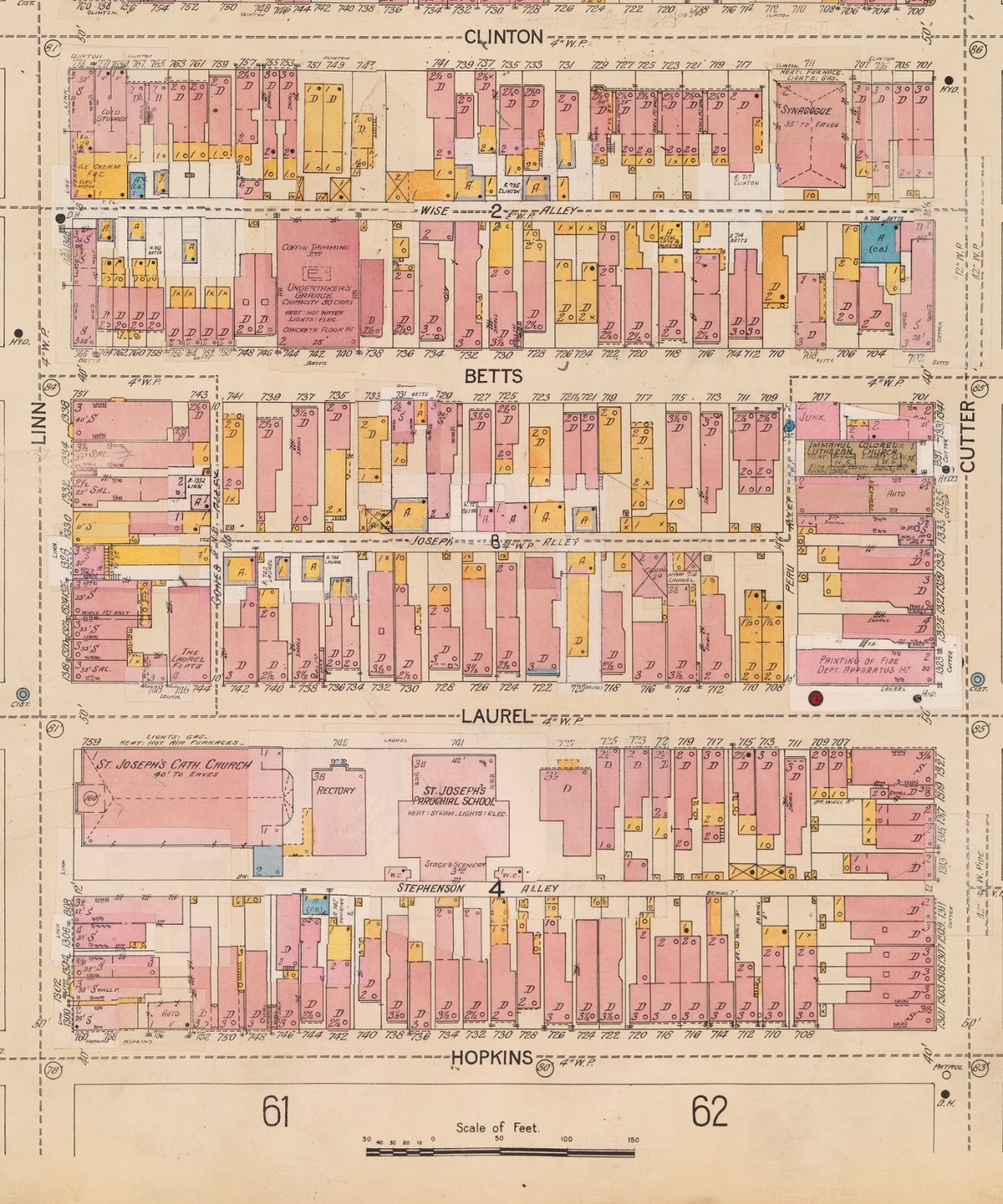
Sanborn Insurance Map - Engine 08 is shown at the corner of Laurel and Cutter.  The scene of the accident, 725 & 727 Clinton Street , is
pictured at the top of the map.  Thomas Bland's residence is just in view as well at 710 Clinton Street.


     Bland would have been very familiar with the location.  He lived just a few doors down the street at 710 Clinton with his wife and two children.  He stepped into an intense scene.  By now others in the neighborhood had heard the commotion and made their way to the backyard and alley to see what was happening.  Bland took action immediately.  He recognized the need for help and sent a boy rushing back to the firehouse to get another firefighter.  The boy found firefighter Harry Heinsheimer, a regular at E08 for about two years now and a resident of the firehouse.  Heinsheimer ran to the scene and found Bland lowering a cistern ladder into the vault.


Courtesy Cincinnati Fire Museum Collection
Engine 08 at the corner of Laurel and Cutter (See above map) as pictured in 1897.


     Harry decided he would make the rescue attempt.  He started down the ladder but it soon began to sink in the muck below.  He rushed back up.  Bland was wearing boots and said he would give it a go.  When he reached the bottom of the ladder he found Monroe.  He took the child in his hands and called for a rope.  Harry lowered one.  Moments later he started to pull the rope when it was jerked from his hands.  A splash followed.  Harry recognized immediately that his partner Thomas had likely been overcome by gasses and collapsed.  He feared both Bland and the child may be lost.

     By now Dr.Wiggers had made it to the scene.  He saw Harry preparing to mount the ladder and warned him that he could easily be overcome as well.  Harry decided to risk it and started down the ladder.  He had nearly reached the bottom when he too was overcome.  The large and growing crowd of onlookers gasped as another splash was heard.

     By now the entire neighborhood was on hand.  Notification had been made to the fire department and members of E08 and Hooks 06 along with Assistant Marshals Campbell and Donovan arrived.  While waiting Officer Lowenstein recognized the need to allow the gasses to vent from the vault.  He took an axe and knocked the privy house down.  Members of Hooks 6 lowered a larger ladder into the vault and Captain Romer tied himself off with rope and brought down a second line.  He descended and found the men floating in the filth below.  After a rope was tied around Heinsheimer he was pulled out and immediately rushed to a nearby fuel house were several doctors started to work on him.  Soon after Bland was pulled up and also taken to the fuel house.  Both were alive but unconscious.  Sadly the child, four year old Monroe Dent, was brought from the privy lifeless.  Soon after both Heinsheimer and Bland were lost.


Cincinnati Enquirer 12 Sept 1899


     Word spread rapidly through the department and city.  Bland and Heinsheimer were hailed as heroes the next day in the papers.  Harry Heinsheimer was buried at the Walnut Hills Jewish Cemetery several days later with a large group of firemen attending the service.  Harry, as a regular member of the department was entitled to benefits paid by the Firemen's Protective Association.  These were rapidly paid to his mother who arrived in town for the service.


Cincinnati Enquirer 12 Sept 1899
Headline that appeared in the Enquirer the day following the tragic loss of Bland and Heinsheimer


     Thomas Bland was also buried on the same day in St Joseph's Cemetery following services at St Xavier Church.  His situation was more complicated than Harry's.  Though a long time member of the department, he was not a regular firemen and therefore not technically entitled to benefits.  The Protective Association recognized immediately he had died while serving in the capacity of a firefighter and voted to pay his widow the firemen's death benefit despite his official status.


Chris & Robert Klein Collection
The headstone of Thomas Bland located in St Joseph's Cemetery, Price Hill

Cincinnati Enquirer 28 May 1900
This is the inscription of the memorial placed in honor of Harry Heinsheimer at the Walnut Hills Jewish Cemetery
A community activist raised money via private subscription to erect the tribute.


Photo: JPeter Collection
Harry Heinsheimer Monument & Headstone
United Jewish Cemetery, Walnut Hills


     Mary Bland suffered through the incident.  She was left alone to raise her two children.  The year had already been tragic for she and Thomas.  Several of their young children had recently died.  Mary herself was also confronted with her crushing past.  Mary's father was William Kelly, was one of the five Cincinnati Firefighter killed at the Gay Fire while working with Engine 04 on December 11, 1880.  This was the single deadliest event in the history of the department.  Mary found herself directly connected to two major losses sustained by the CFD.  She also had to fight for a pension that was needed to help her cover expenses without her husband's income.  Since he was not technically a regular firefighter the state legislature had to pass a resolution directing Cincinnati to add his name to the pension roll.  The bill was widely supported by members of the department and found champions in both chambers of the legislature.  A few voiced opposition fearing it would establish a precedent that could drain the system but their view was not widely held.  After months of fighting, Mary finally won her claim to a widows pension.


UC Cincinnati Birth & Death Index
Harry Heinsheimer Death Index Card - Cincinnati Vital Statistics

UC Cincinnati Birth & Death Index
Thomas Bland Death Index Card - Cincinnati Vital Statistics

UC Cincinnati Birth & Death Index
Monroe Dent Death Index Card - Cincinnati Vital Statistics


Overlay of the old Sanburn map of the location of 727 Clinton Street with the current Google Map of the same area.
Betton Street was formerly Clinton Street.  Location of accident indicated in both by red dot.
 Street Name Changes (Old > Current)
Laurel > Ezzard Charles
Cutter > Laurel Park Drive
Clinton > Betton


Google Street View
The site of the rear of 727 Clinton Street as it appears today - Clinton Street is now known
as Betton Street.  The frontage of 727 Clinton is approximately the same location as 713 Betton.  Pinecone Lane 
roughly corresponds to the location of Wise Alley.  The Privy house was in the rear of 727 Clinton near Wise Alley.


Thomas Bland & Harry Heinsheimer can be found among the names

The Roll of Honor also contains the name of Mary Bland's father William Kelly